• Skip to main content
  • Skip to footer

Tracy Stanley

Consultant | Author

  • Articles
  • Books
    • Crime Quiz
    • Cannes Encore!
    • Soft Nut Bike Tour of Burma
    • Change Stories
    • Creativity Cycling
    • Engagement Whisperer
  • Podcasts
  • Newsletters
  • Contact

Articles

What a manager can do to build a creative culture

February 25, 2020 by Tracy

@knobelman on @Unsplash

When you think about why some organisations are more creative than others, you often identify culture as the driver.  But what is culture and how does it impact on an individuals’ willingness to do things differently?

Culture is a big and complex concept. It covers habits, behaviours, processes, attitudes, artefacts, among others and is often described in a nutshell ‘as the way that things are done around here.’ Organizational culture can manifest itself in a variety of ways, including leadership behaviours, communication styles and decision-making processes. While it can be hard to describe, culture is something you can often feel after a short time within an environment.

It’s hard to be creative at work if the culture does not support thinking differently and taking risks. In this blog, I’m going to discuss a few things managers can do to build a create a team environment, for new ideas to flourish. I’ll be touching on the importance of autonomy, time for play and experimentation and expectations. My thoughts are based on my experience inside organisations and from my PhD research.

Autonomy

Giving your team members freedom and autonomy in how they undertake their work is very important for creativity. Resist the urge to meddle or micromanage their activities and give praise and feedback to encourage further exploration of new ideas.

Time

Having enough time to explore a problem and to consider alternatives, supports for discovery of new approaches. If people don’t have discretionary time, they will resort to doing things the way they’ve always been done. People need time to experiment and play with ideas.

Time is a curious thing. If you have no time to think broadly and to experiment, you will do an activity as you always have. However, if you have too much time you may lack focus. My PhD research confirmed the findings of others that there is a ‘sweet spot’ with regard to the right amount of time to support creativity.

Expectations

If you’re a manager, your team will quickly pick up on your interest in and desire for new ideas. Giving permission to challenge assumptions, creating openness to new ideas, and giving freedom to experiment and learn all build a creative culture, as does an acceptance that failure is a component part of the exploratory process.

As a leader you should model creative behaviours such as being curious and taking time to consider different ways of doing things. Allowing times for discussion of new ideas and reflection on past activities in team meeting will reinforce a learning culture. I’ll talk more about processes  you can use to support a culture of innovation in a future article.

References

Creativity Cycling: Help your team solve complex problems with creative tools by Barbara Wilson and Tracy Stanley 2018

Work environments, creative behaviours and employee engagement (Doctoral dissertation, Queensland University of Technology).


Filed Under: Tracy Stanley News

Podcast 1 – Discussing creativity in the workplace

February 24, 2020 by Tracy

Are you interested in learning more about encouraging creativity in the workplace and at home?

Barbara and I have started recording our monthly chat about creativity, a topic that we’re both passionate about. We are the co-authors of the book Creativity Cycling: Help your team solve complex problems with creative tools.

A link to our first conversation touching on mindsets, motivations and culture is provided below.

Link to Podcast

    Filed Under: Tracy Stanley News

    Getting unstuck through opposite thinking

    December 2, 2019 by Tracy

    When you’ve been stuck searching for a solution to a wicked problem, have you tried Opposite Thinking? This involves taking an opposite approach to solving the problem and identifying those things that will help you to achieve the opposite of what you really want to achieve. Instead of asking,

    ‘How do I solve or prevent this problem?’ ask,

    ‘How could I make the problem worse?’

    This discussion can be fun and provide new insights into the problem, which then helps you to identify new solutions.

    Barbara Wilson describes how to undertake negative brainstorming in our book, Creativity Cycling: Help your team solve complex problems with creative tools. She suggests that if you are working with a team, use a brainstorming approach to identify different ways that you can avoid or stop the problem from being solved. Put your ideas up on a whiteboard so everyone can see them. Then use a reversal exercise to discuss how you could turn each idea into something positive.

    I’ve talked previously about the importance of identifying the assumptions we have about a problem, and about the solution, as they can constrain our thinking. I found an interesting video that presents an approach that maps out our assumptions as a first step in engaging in opposite thinking. Here’s a link to the video from Board of Innovation which will give you more ideas on how you can shake up your thinking to knotty problems.

    References

    Creativity Cycling: Help your team solve complex problems with creative tools by Barbara Wilson and Tracy Stanley

    Negative Brainstorming Link

    Mindtools article

    Image source

    Filed Under: Tracy Stanley News

    Entrepreneurial journey: The Speckio Story

    November 14, 2019 by Tracy

    Many of you will be familiar with the Chinese proverb –

    A journey of a thousand miles starts with a single step

    In the case of a Startup weekend, the journey starts with a lightning-fast, 10 000 metre sprint.

    Except you’re not running the race on your own: you’ve just formed a team with people you don’t know who you’ll need to rely on to cross caverns and scale mountains. It’s all rather nerve wracking.

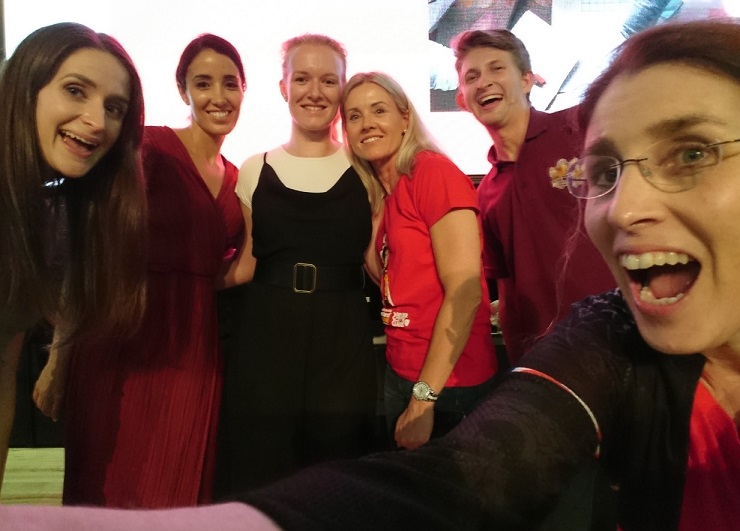
    On 22 September, Team Speckio won the Global Techstars Startup Weekend Women event with their idea being to use behavioural nudges to raise self-awareness and understanding of others.

    The event was held at the River City Labs in Brisbane and the team comprised –  Christina Cardarello, Britt Furlanis, Patrice Cotter, Tanya O’Shea, myself Tracy Stanley and Michael Moore. (Michael was invited to join the team when we recognised we would benefit from additional tech skills. He had come along to the event to support his Mum who was in one of the other teams).

    [READ MORE]

    Filed Under: Tracy Stanley News

    Marvelous metaphors

    October 25, 2019 by Tracy

    I suspect we’re not aware of how often we use metaphors to explain something through the lens of something else. Let me provide a few examples.

    In Australia, metaphors are generously sprinkled throughout our language. For example,

    A dog’s breakfast

    meaning a messy or complicated situation, while being

    Mad as a cut snake

    describes someone who is really angry.

    Metaphors help us to think and see and feel and experience a situation through another sensory lens. (And sometimes to mix humour into an explanation).

    Tom Albrighton talks about metaphors as bridges from the close and familiar to the distant and strange, explaining the unknown in terms of the known. He adds that metaphors are valuable tools in business, particularly when people need to communicate complex and dry ideas. By their very nature they are imperfect. Like spotlights, they illuminate some things while leaving others in the dark. This means they sometimes outlive their usefulness.

    Sophie Playle beseeches writers to use metaphors as they surprise the brain. They can simultaneously make writing delightfully succinct while concentrating meaning. I like how she proposes that you pair two unexpected images to interrupt your reader’s expected train of thought. This is similar to the process used in innovation of combining two products to create something entirely new and unexpected such as the wine press and coin punch to make the printing press or more recently a winter coat that doubles as a sleeping bag.

    [READ MORE]

    Filed Under: Tracy Stanley News Tagged With: Creativity

    The importance of knowledge management and of not losing old ideas

    September 30, 2019 by Tracy


    Photo by Leslie Holder on Unsplash

    Where does critical knowledge reside in your organisation? In a database? In SharePoint? In people’s heads?

    I remember Glen Carlson of Key Persons of Influence saying that –

    the gap between where you are and where you want to be – is often knowledge

    It’s an empowering statement.

    So where do you acquire and keep this knowledge?

    We live in a world where knowledge is plentiful and there are many knowledge capture systems inside and outside of our organisations.

    But do we use them? Are you able to find the knowledge that we need when we need them or do we spend hours trawling through websites and data bases?

    [READ MORE]

    Filed Under: Tracy Stanley News

    • « Go to Previous Page
    • Go to page 1
    • Interim pages omitted …
    • Go to page 3
    • Go to page 4
    • Go to page 5
    • Go to page 6
    • Go to Next Page »

    Footer

    Social media hangouts

    • Email
    • Facebook
    • Goodreads
    • Instagram
    • LinkedIn
    • Pinterest
    • Threads
    • YouTube

    Recent Posts

    • Inspiration for Crime Quiz
    • Launch of Crime Quiz
    • Learning, laughter and letting go of your writing fears…
    • Travels with my husband
    • Favourite Change Tools, Templates and Processes

    Copyright © 2026 · Author Pro on Genesis Framework · WordPress · Log in